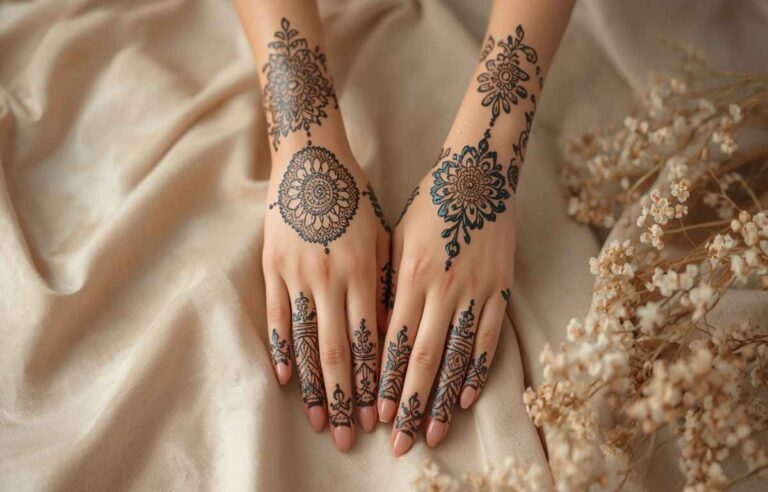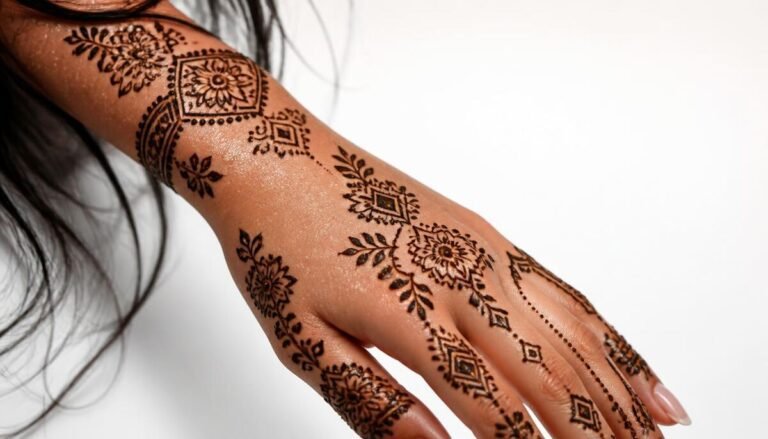
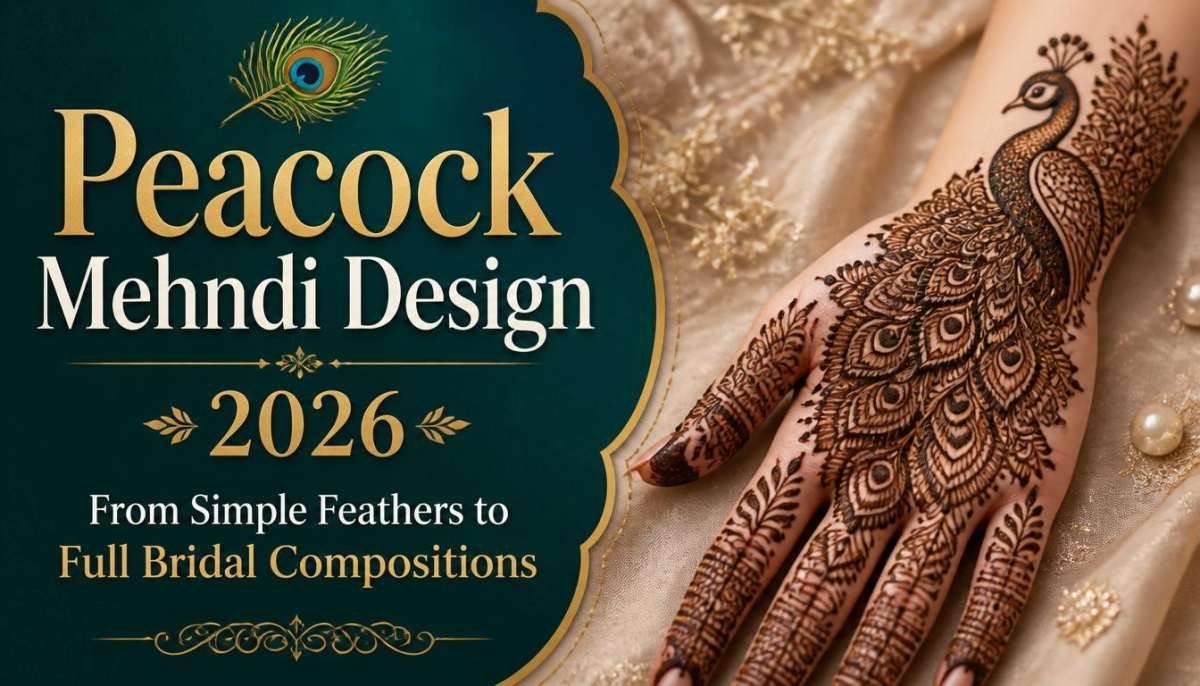

A peacock mehndi design is one of those styles where the artist’s skill level becomes immediately visible. A well-drawn peacock with a clean body, proportional tail, and balanced feather detail looks like genuine art. A rushed one looks like a bird that lost a fight.
That’s exactly what makes this motif so rewarding when it’s done right. The peacock’s natural shape follows the hand’s contours better than almost any other mehndi subject. The curved neck sits naturally on the palm. The tail feathers spread across the fingers as if the design was made for that space. No other mehndi motif uses the hand’s shape as intelligently as a peacock does.
Why Peacock Mehndi Design Never Goes Out of Style
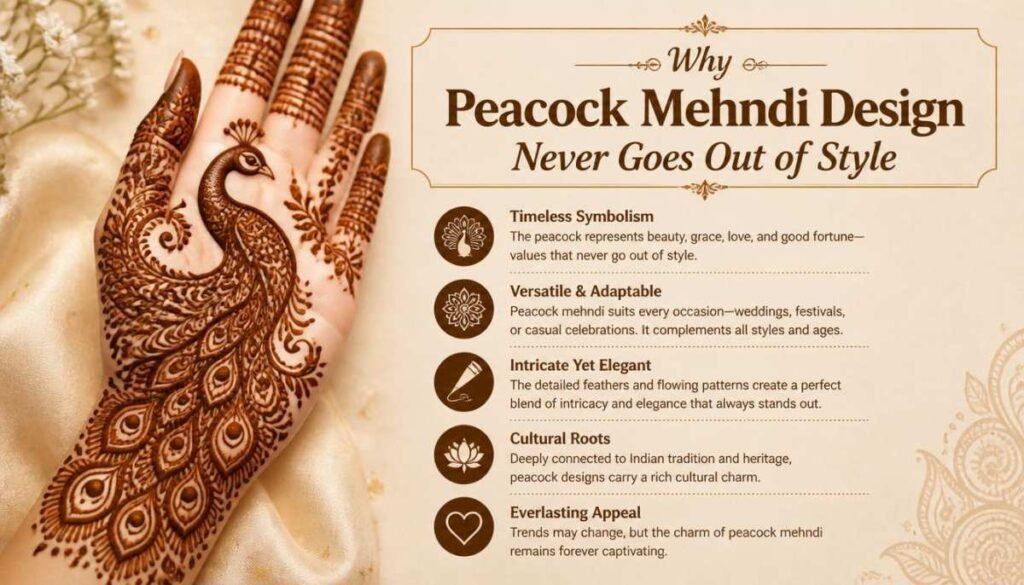
Most mehndi trends come and go. Geometric patterns peak and fade. Specific floral combinations go in and out of fashion. The peacock hasn’t moved from its position as one of the most requested mehndi motifs in decades and the reason is structural rather than cultural.
A peacock gives an artist complete design freedom within a recognizable framework. The body anchors the composition. The tail provides direction and movement. The feather details can be as simple or as elaborate as the occasion demands. That flexibility is what keeps peacock mehndi relevant across every occasion type, from a five-minute finger design to a six-hour bridal session.
Mor Pankh vs Full Peacock: Two Very Different Designs
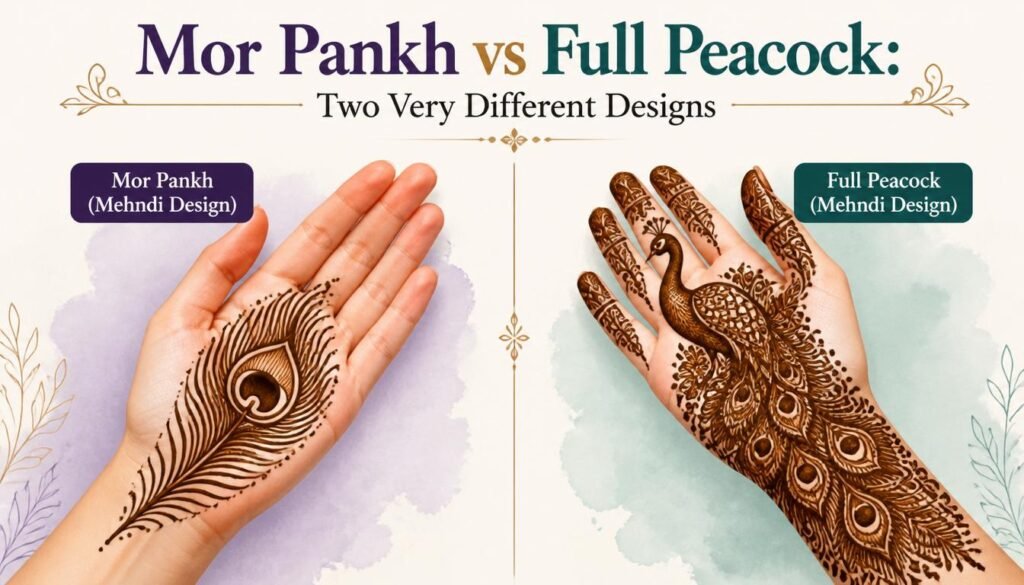
Most guides treat peacock mehndi as a single category. It isn’t. The difference between a mor punk design and a full peacock body design is significant enough that choosing the wrong one for your occasion changes the entire outcome.
Mor Pankh Minimal and Modern
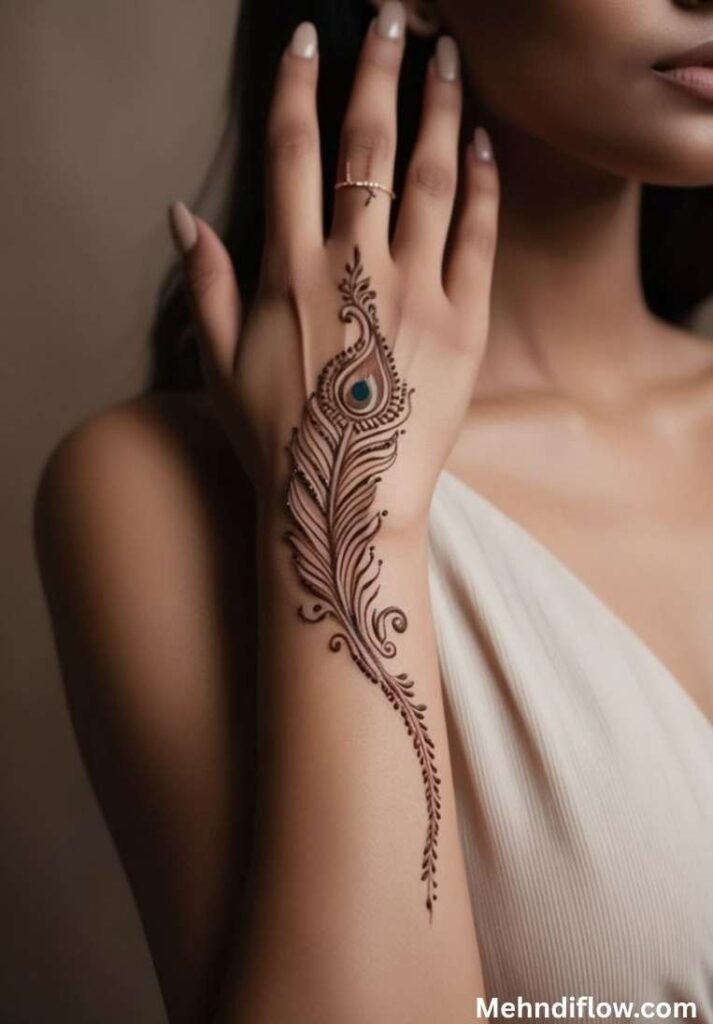
Mor pankh means peacock feather, just the feather, without the bird’s body. A single elongated feather with a teardrop eye at the top and fine barb lines radiating downward is a complete design on its own.
It reads as elegant and contemporary rather than traditional, which is why it has become popular with women who want mehndi that feels modern without abandoning the peacock motif entirely.
A single mor pankh on the back of the hand, placed vertically with the eye near the wrist and the feather tip reaching toward the middle finger, is one of the cleanest minimal mehndi compositions available.
It suits office wear, casual Eid, and any occasion where full coverage isn’t expected but something intentional is.
Full Peacock Body Traditional and Elaborate
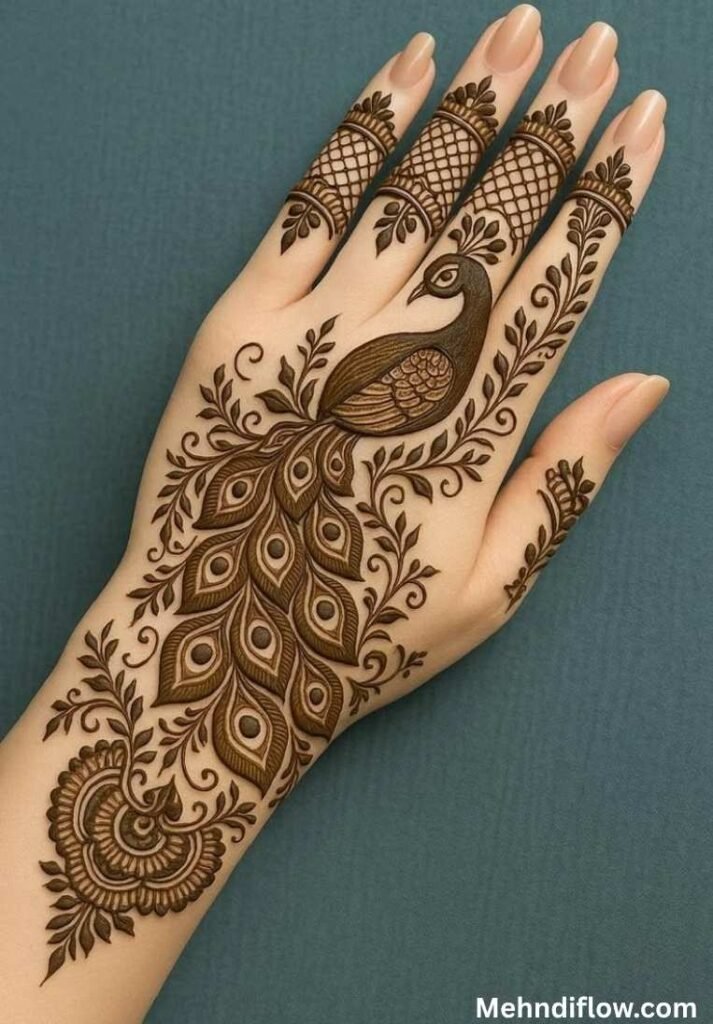
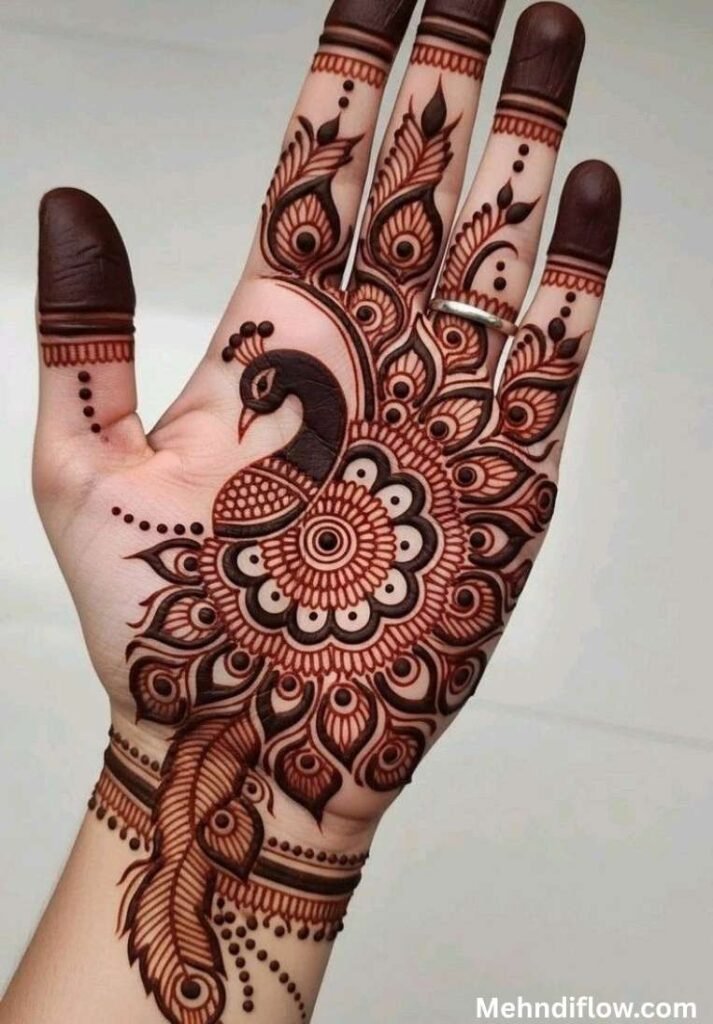
A full peacock design includes the body, neck, head, and tail together as a single composition. The body requires more precision than the feather alone. The curve of the neck, the body’s proportion, and the way the tail emerges from behind the body all need to work together for the design to look balanced.
This version suits festive occasions, mehndi ceremonies, and bridal applications where the design is meant to be noticed and read as a complete artistic statement.
The full body version takes significantly longer to execute well, which is why it appears more often in professional bridal applications than in self-applied or quick event mehndi.
Simple Peacock Mehndi Design for Beginners
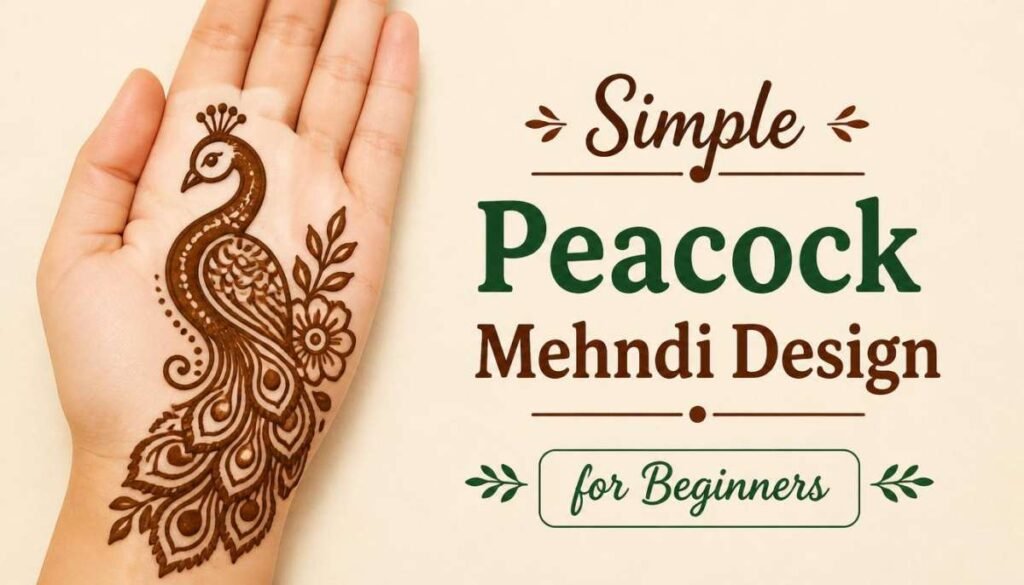
Simple peacock mehndi isn’t about making the peacock smaller. It’s about reducing the number of elements while keeping the design recognizable and clean.
Outline-Only Peacock: Where to Start
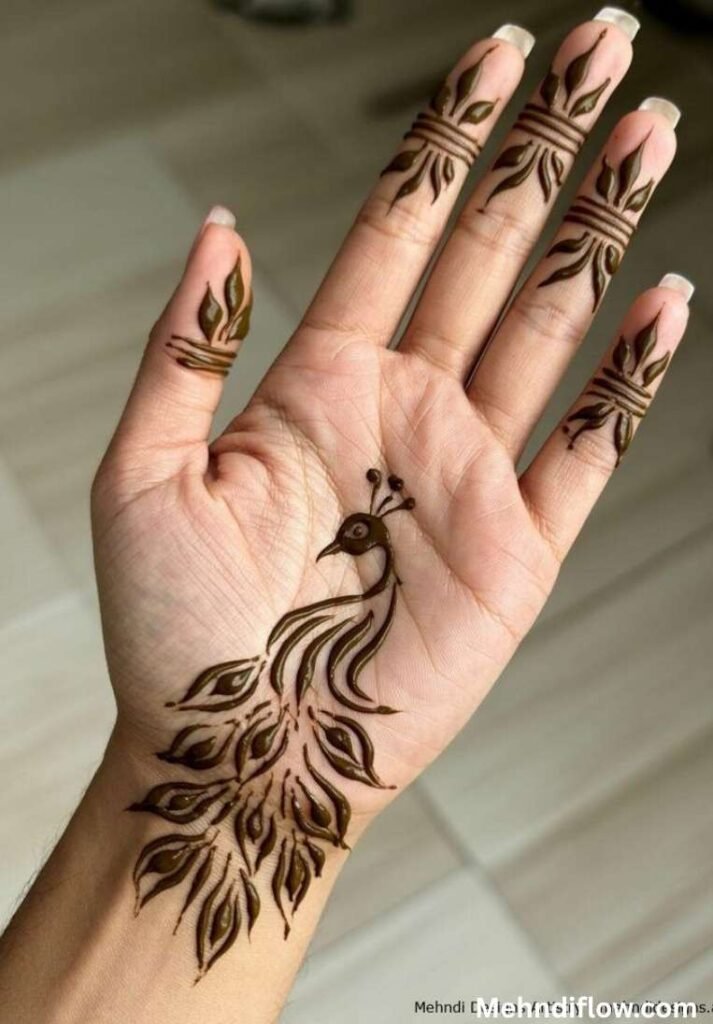
An outline-only peacock body and tail drawn with a single clean line, no internal fill, no crosshatching, and no detailed feather work, is the most forgiving starting point for beginners. The silhouette of a peacock is distinctive enough to read as a peacock even without internal detail, which means a clean outline with a few dots around the tail looks complete rather than unfinished.
This version works best on the back of the hand, where the full shape has room to breathe. On smaller placements like the wrist or a single finger, simplify further to just the neck and head or a single feather.
Single Feather on One Finger Smallest Complete Design
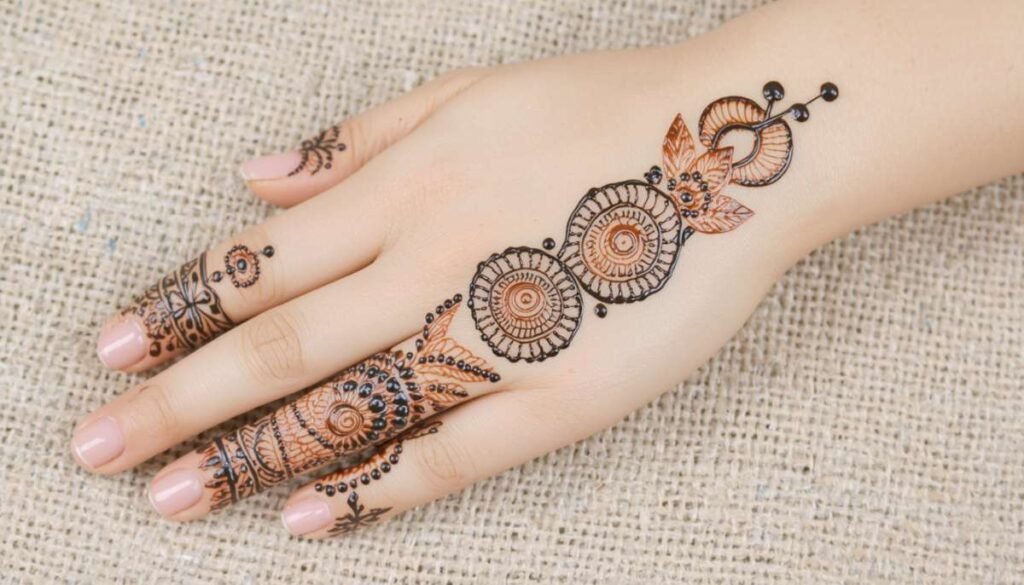
A small mor pankh placed along the index or middle finger feather tip at the base, eye near the fingertip is the smallest version of peacock mehndi that still reads clearly as a peacock motif. It takes under five minutes, requires no complex technique, and pairs naturally with simple dot work on the surrounding fingers.
This is the version most school girls and office-going women choose when they want peacock mehndi without committing to a full hand design.
Peacock Mehndi Design for Back Hand
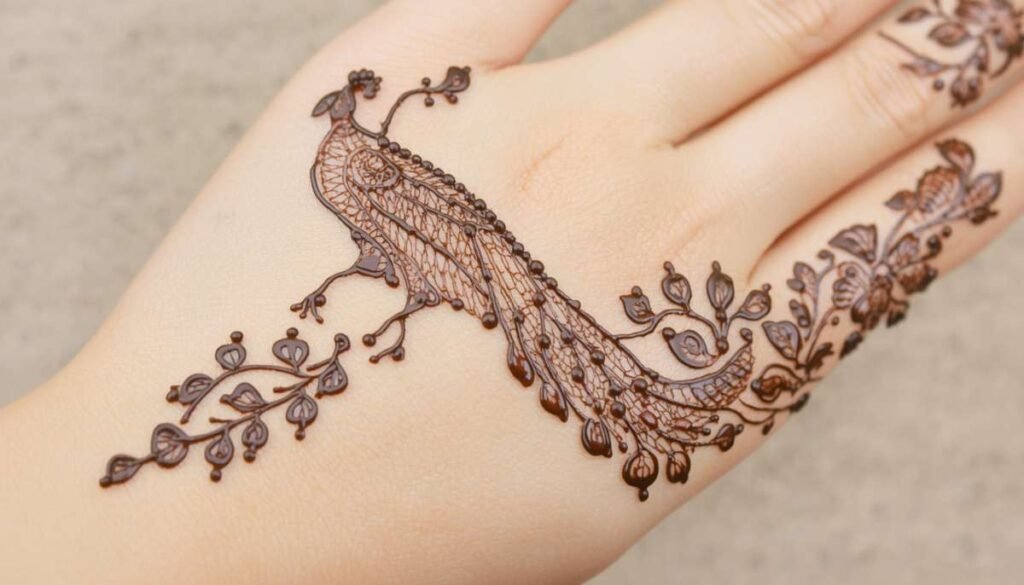
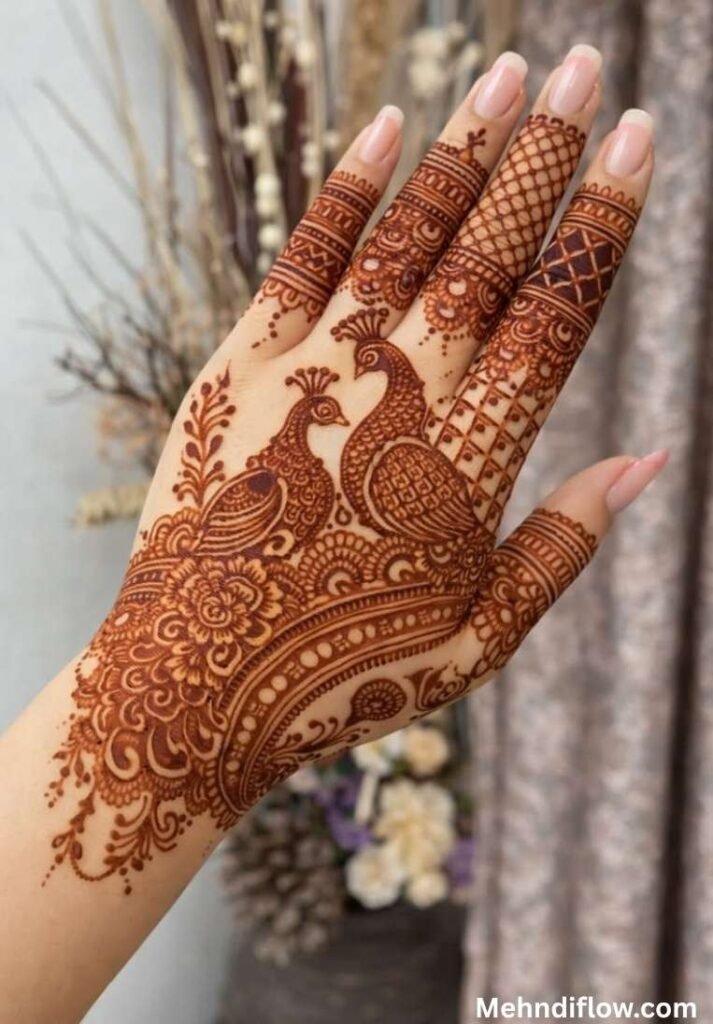
The back of the hand is where peacock mehndi performs best. The flat surface gives the peacock’s shape room to be read clearly, and the fingers provide a natural extension for the tail feathers.
Peacock Facing the Wrist Classic Composition
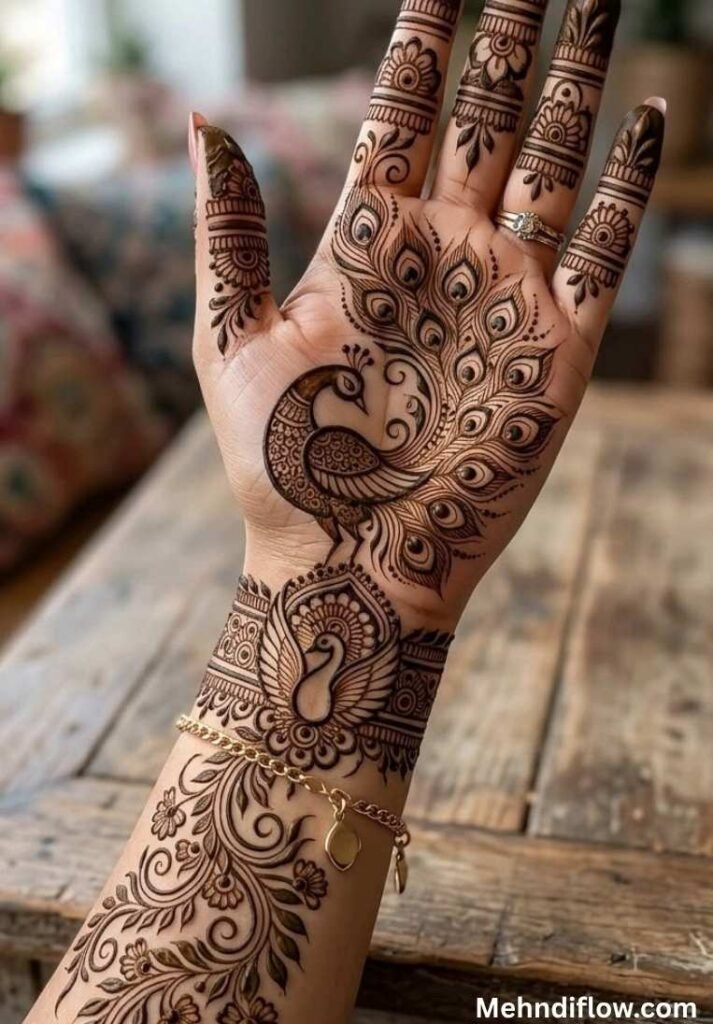
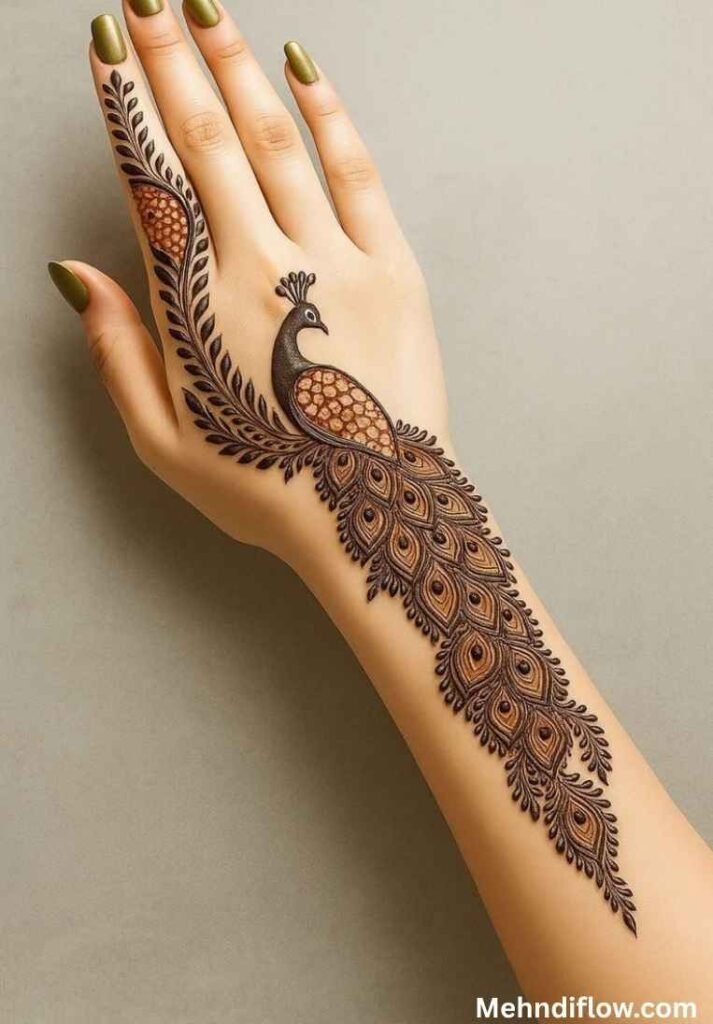
The most common backhand peacock composition has the bird facing toward the wrist body at the center of the hand, neck curving downward, head near the wrist with a small crest detail. The tail then fans upward toward the fingers, with individual feathers trailing along each finger.
This orientation works because the eye naturally follows the peacock’s body from wrist to fingertips, which means the design reads in the same direction the hand is usually viewed from wrist outward.
Peacock with Floral Tail Spread Across Fingers
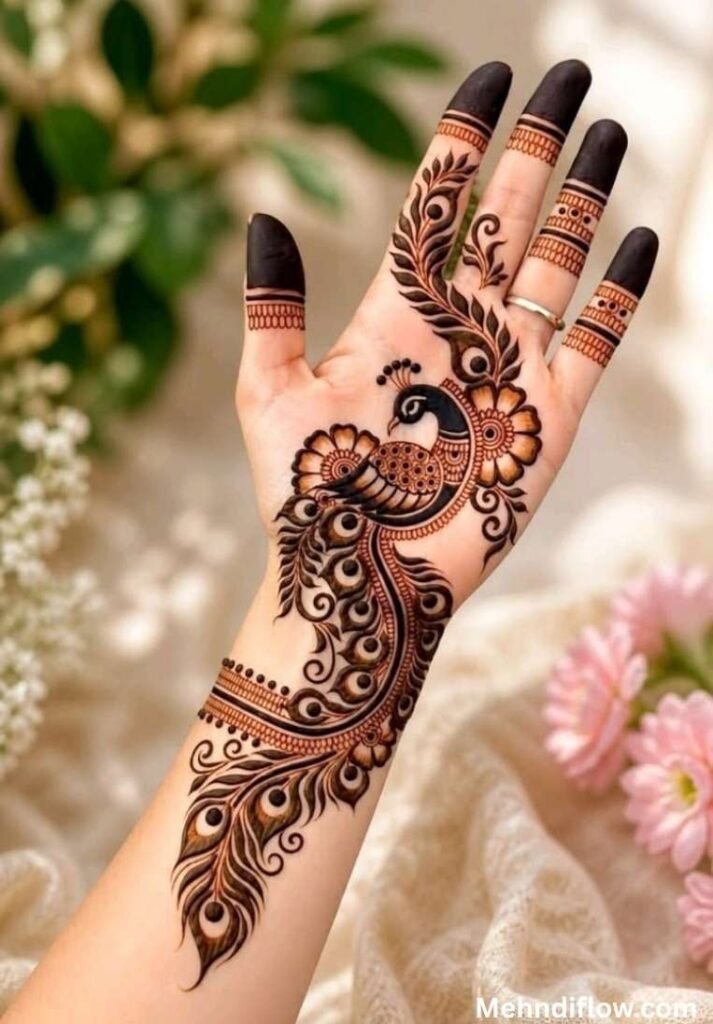
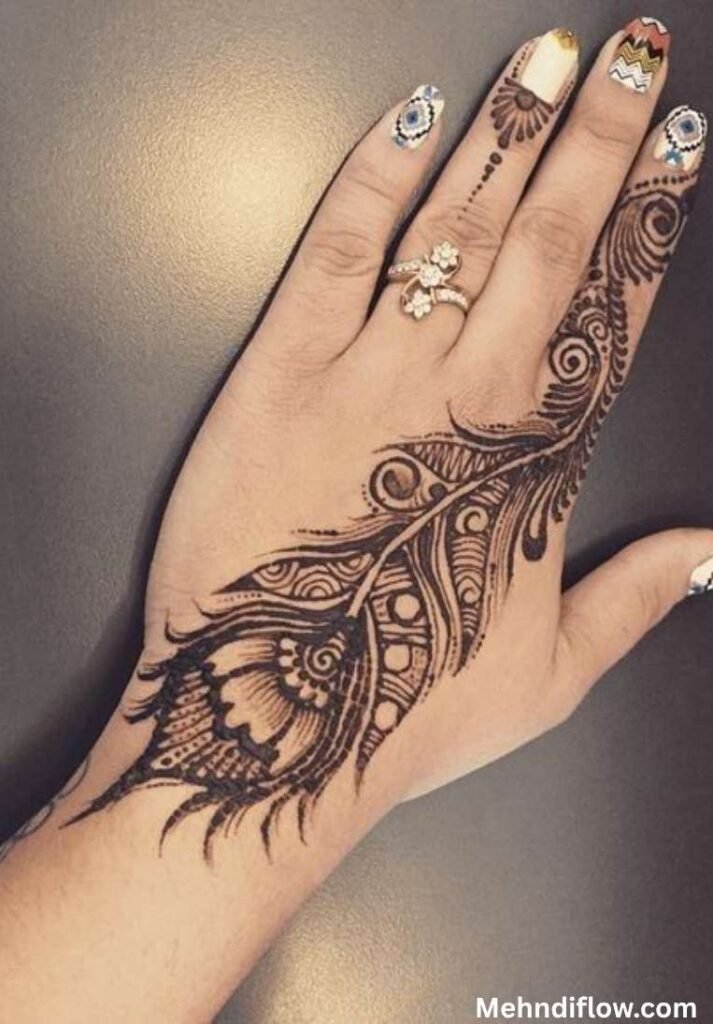
Rather than drawing individual feather lines along each finger, replacing the tail feathers with small florals one flower per finger, connected by thin vines back to the peacock’s body, creates a composition that feels more organic and less geometric than a traditional feather tail.
This variation is particularly effective for brides and wedding guests because the floral tail elements look rich and detailed from a distance, while the peacock body gives the overall design a clear anchor point.
Peacock Mehndi Design for Palm
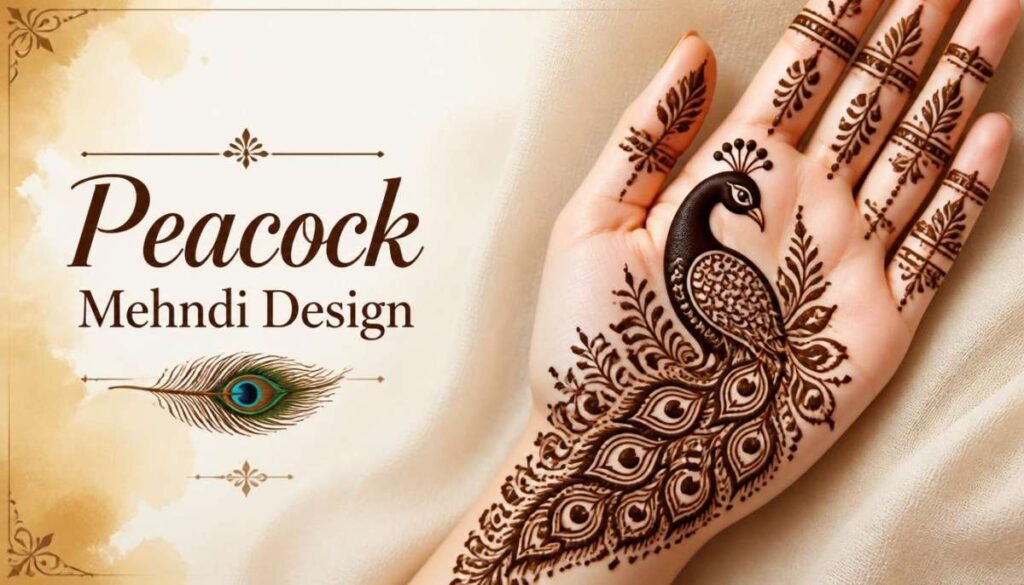
Palm placement changes how a peacock design works because the hand’s natural creases run through the design rather than sitting behind it. An experienced artist uses those creases as design lines rather than working around them.
Centered Peacock on Palm Bold Statement
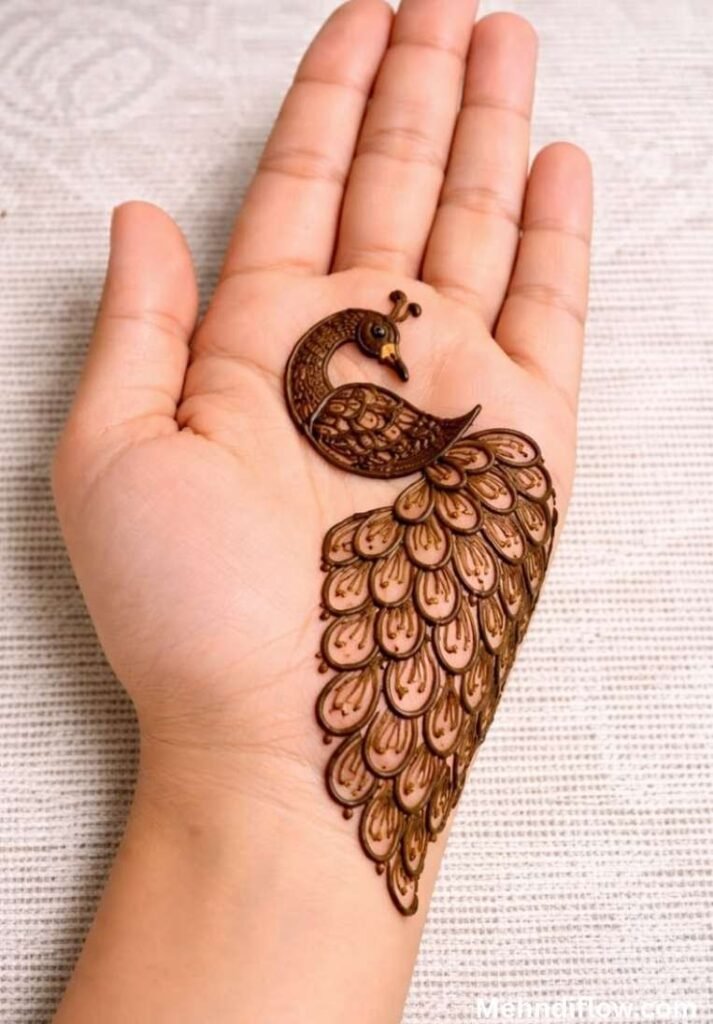
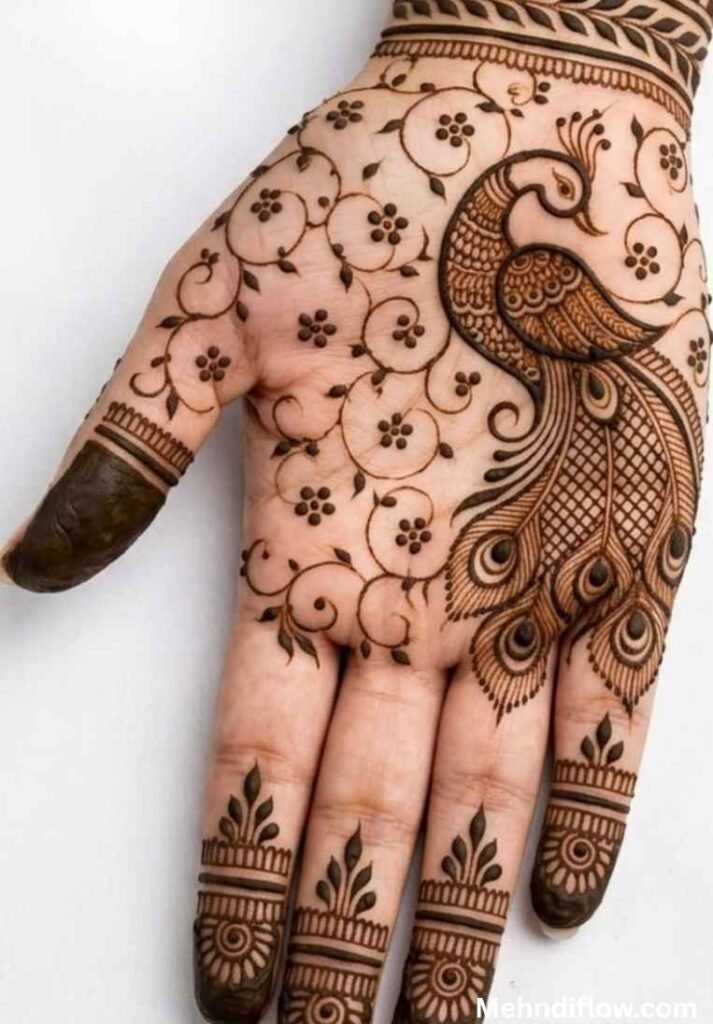
A peacock centered exactly on the palm body facing upward, tail spreading downward toward the wrist creates an immediate visual impact that back-hand placement doesn’t quite achieve. The palm’s center position means the design is seen first when a hand is extended, which makes this placement popular for engagement and nikkah occasions where the hand is displayed frequently.
The tail in a centered palm peacock usually ends at the wrist rather than extending onto the fingers, keeping the design contained and proportional to the available space.
Half Peacock Emerging from Wrist
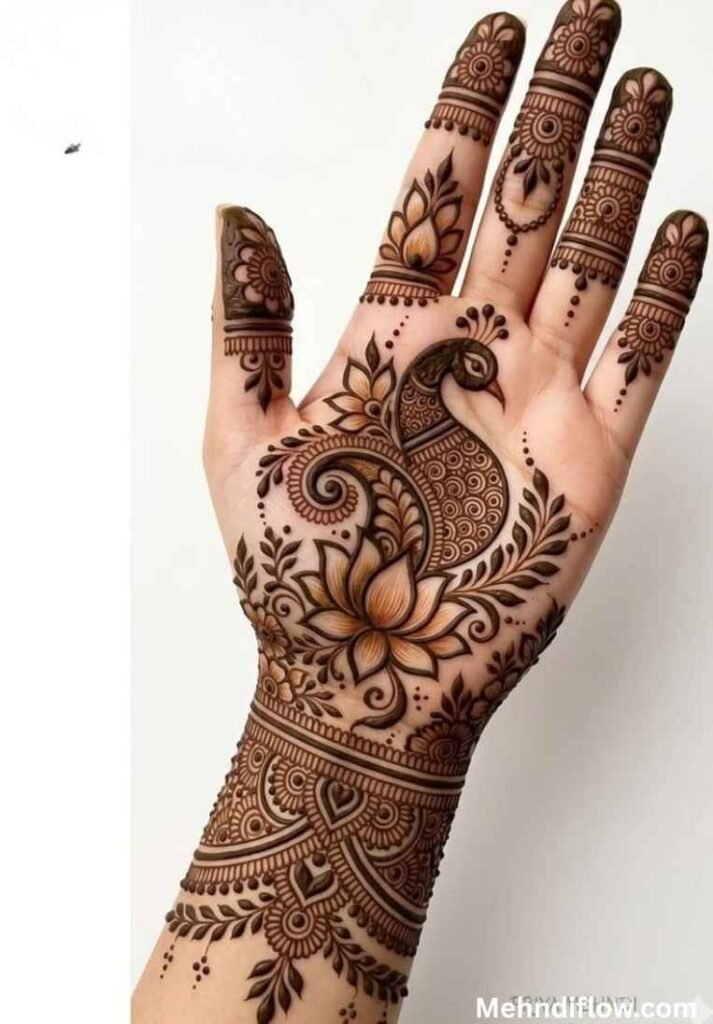
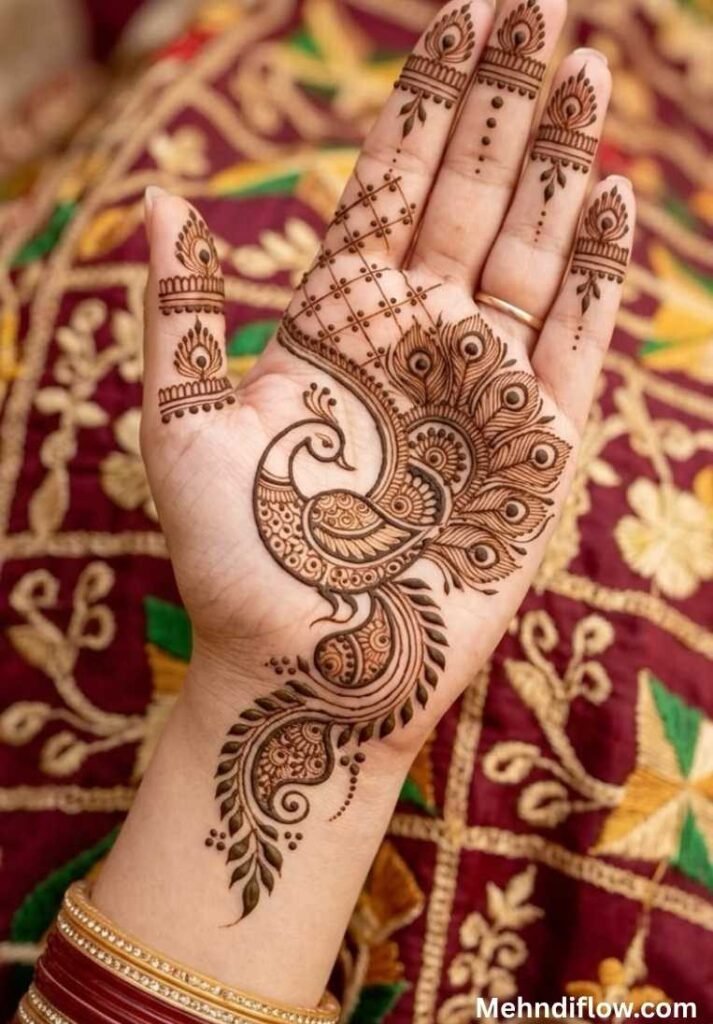
A half-peacock composition shows only the upper portion of the bird, the neck, head, and front body emerging from the wrist, as if the peacock is walking onto the palm from below. The tail is implied rather than fully drawn, with a few trailing feather lines visible at the wrist edge.
This composition is one of the most elegant palm peacock designs because the partial reveal creates more visual interest than a fully visible bird. It also suits smaller hands and palms, where a full peacock body would feel crowded.
Arabic Peacock Mehndi Design Bold Lines, Open Space
Arabic peacock mehndi uses the same bold stroke principles that define Arabic henna generally thick outlines, intentional negative space, and motifs that read clearly from a distance. Applied to a peacock, this means a broader body outline, fewer but more confident feather lines, and significantly less internal fill than traditional Indian-style peacock mehndi.
The result photographs better than dense traditional peacock designs because the strong contrast between the bold henna lines and the open skin makes the design legible in photographs taken from any distance. For brides who want peacock mehndi that looks striking in wide-angle wedding photography as well as close-up shots, Arabic-style peacock achieves that balance better than any other approach.
Peacock Mehndi for Bridal
Dual Peacock Composition Both Hands Facing Each Other
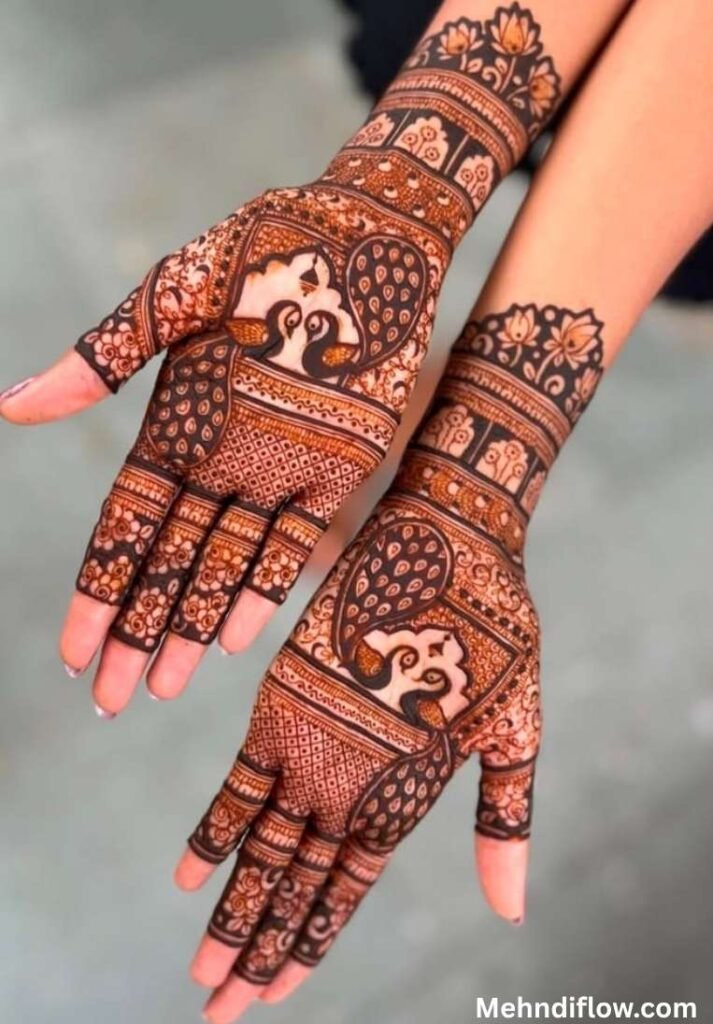
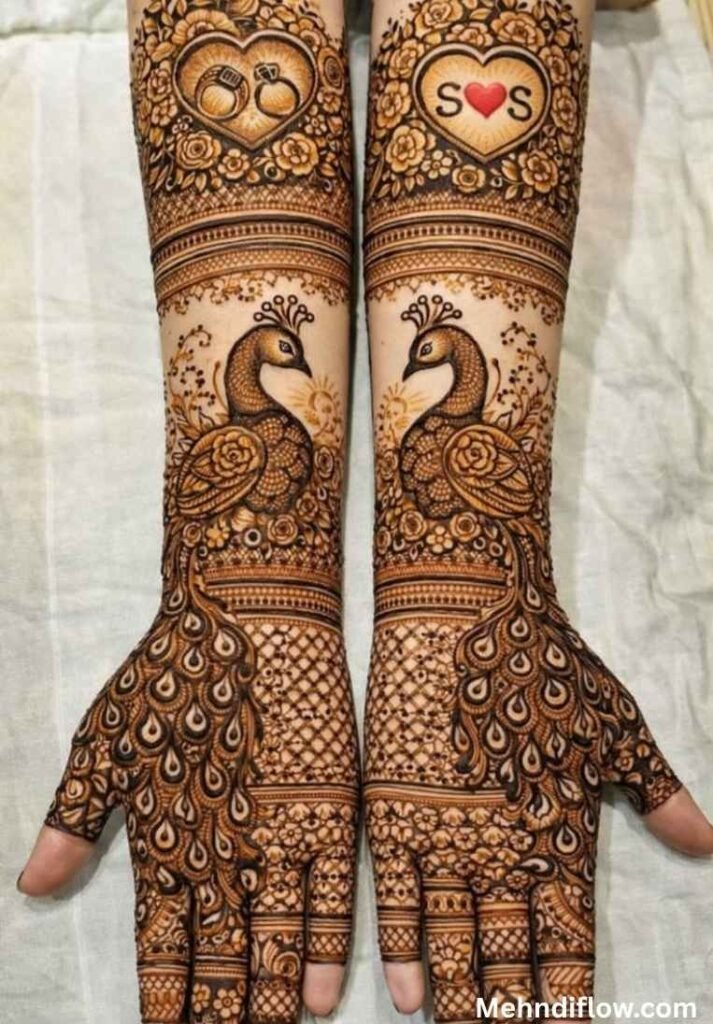
The most classic bridal peacock composition uses matching peacocks on both hands — one facing left on the right hand, one facing right on the left hand — so that when the hands are placed together, the peacocks appear to be facing each other. This mirrored composition is one of the strongest visual statements in bridal mehndi and one of the reasons peacock motifs have remained so consistently popular in South Asian wedding traditions.
Executing this well requires planning both hands as a single composition from the start rather than completing one hand and then trying to mirror it. A skilled bridal mehndi artist maps both designs simultaneously before beginning application on either hand.
Peacock as Accent in Full Bridal Coverage
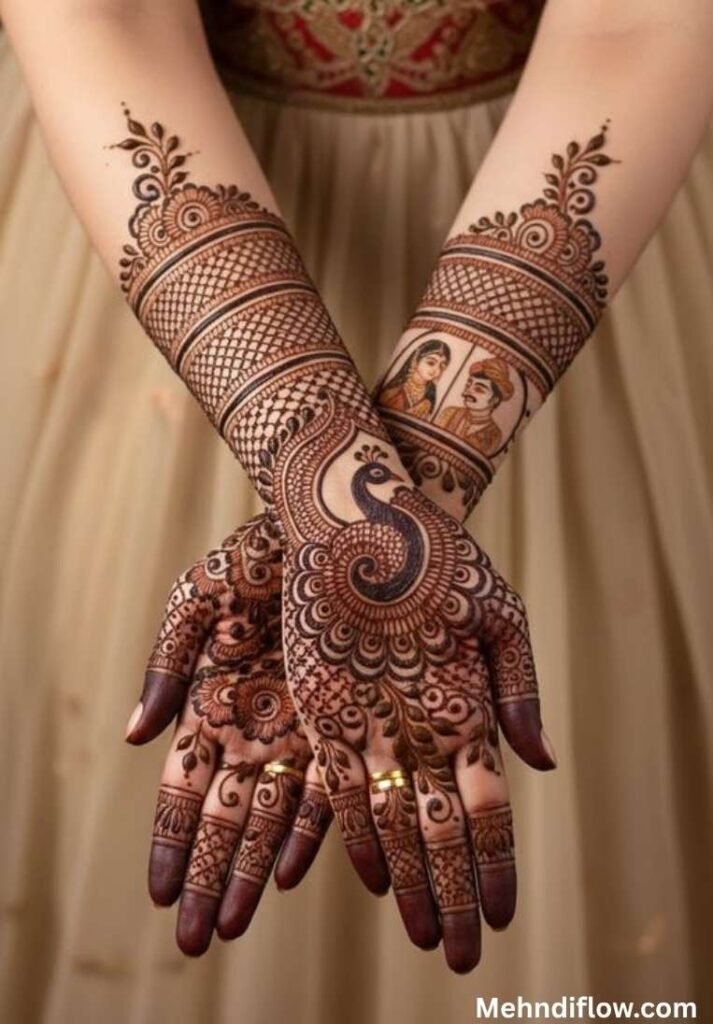
In full-coverage bridal mehndi where both hands and forearms are entirely covered
individual peacocks appear as accent elements within a larger composition rather than as the centerpiece. A small peacock tucked between paisleys near the forearm, or a pair of peacocks framing a central lotus on the back hand, add narrative detail to a dense design without requiring the peacock to carry the entire composition.
This use of peacock as a supporting element rather than the hero works particularly well for brides who want traditional full-coverage mehndi with a recognizable motif that can be pointed out in photographs.
Peacock Mehndi for Eid 2026
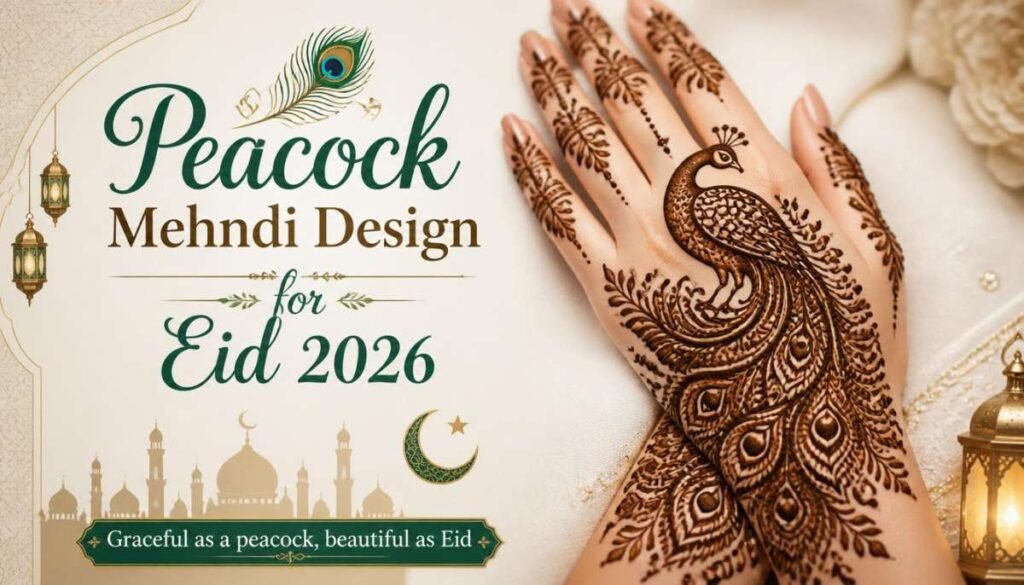
Eid peacock mehndi in 2026 is leaning toward mor pankh designs and Arabic-style peacocks rather than the dense traditional full-body compositions. The preference for designs that look intentional without being heavy reflects a broader shift in how younger women approach Eid mehndi something that photographs well for reels and social posts without requiring a two-hour application session.
A single Arabic-style peacock on the back hand with a dot bracelet at the wrist, or a mor pankh on one finger paired with minimal dot work on the others, hits the right balance between festive and everyday. Both dry faster than dense traditional designs, which matters for Eid morning routines where mehndi is often applied alongside getting dressed and ready.
How to Draw a Peacock in Mehndi The Right Starting Point
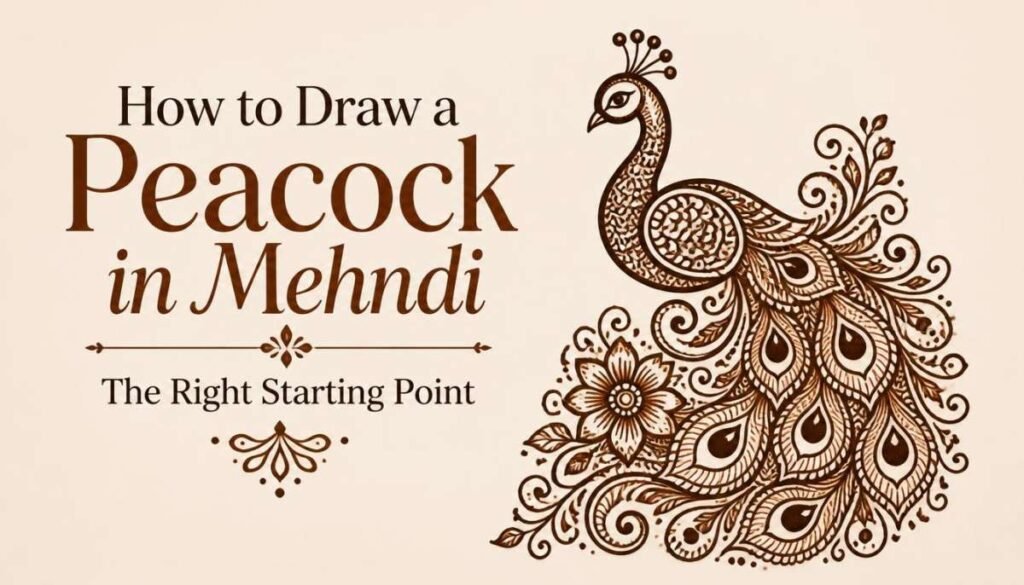
Most beginners start with the tail feathers because they seem like the most interesting part. This is the wrong order and almost always produces a peacock with a body that doesn’t fit the remaining space.
Drawing the Body First
The body should be the first element a small teardrop or oval shape placed exactly where you want the peacock to sit. The size of this body determines everything else. Too large and the tail has nowhere to spread. Too small and the tail overwhelms the body and the design looks unbalanced.
Once the body is placed, add the neck as a curved line extending from the front of the body, and the head as a small circle at the top of the neck. A small crest two or three tiny curved lines at the top of the head completes the recognizable peacock silhouette before any tail work begins.
Building the Tail Feathers Outward
After the body and neck are established, the tail builds outward from behind the body in a fan shape. Start with the longest central tail feather first, then add progressively shorter feathers on each side. This creates the natural peacock tail spread without the feathers crowding unevenly.
Each feather ends in a teardrop eye the most recognizable peacock detail in mehndi. These eyes can be left as simple outlined teardrops for a minimal look, or filled and surrounded by fine circular lines for a more elaborate traditional finish.
3 Mistakes That Ruin a Peacock Mehndi Design
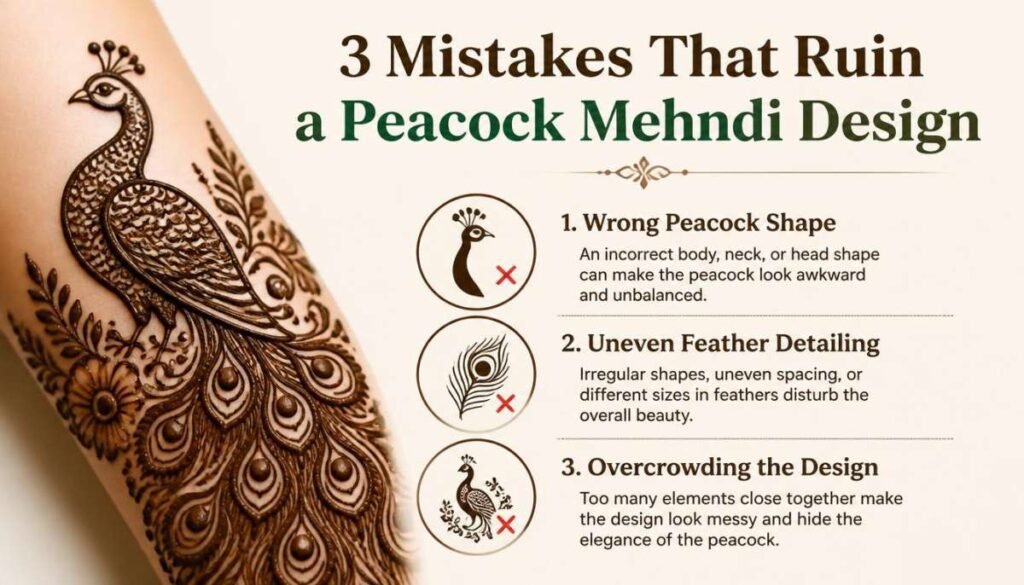
Starting with the tail instead of the body. The body is the anchor. Without establishing its size and position first, the tail has no proportional reference and the finished peacock almost always looks like the body was added as an afterthought rather than the starting point.
Making the neck too short. A peacock with a short neck looks like a pigeon. The neck should be long enough to give the head clear separation from the body — this single detail is what makes a mehndi peacock immediately recognizable versus vaguely bird-shaped.
Overloading the feather detail. Too many lines inside each tail feather makes the individual feathers merge into a dark mass once the henna stains. Feather lines need enough space between them to remain distinct after staining. Fewer, more spaced lines always produce a cleaner result than dense crosshatching inside the feathers.
Preview Your Peacock Design Before You Apply
Peacock mehndi depends more on placement and proportion than most other mehndi styles. A peacock that fills a reference photo perfectly may be too large for a smaller hand or too small for a wider palm, and repositioning isn’t possible once the application has started.
MehndiFlow’s AI Mehndi Design Generator lets you preview peacock styles and placements before picking up the cone. Testing the composition digitally first, specifically checking that the body size suits your hand and the tail has room to spread naturally, produces consistently better results than going in with a reference image alone.
Final Thoughts
Peacock mehndi design earns its status as one of the most enduring mehndi motifs because it genuinely uses the hand as a canvas rather than just decorating it. The body anchors, the neck directs, and the tail fills every part of the peacock serves a compositional purpose that most other mehndi motifs don’t have.
Whether it’s a single mor pankh on one finger or a full dual-peacock bridal composition across both hands, the quality of a peacock design comes down to proportion and starting order. Get the body right, build the neck before the tail, and leave enough space between feather lines for the stain to read clearly. Everything else follows from those three decisions.
FAQ’s
What is the difference between Mor Pankh and a full peacock mehndi design?
A Mor Pankh mehndi design features only the peacock feather, making it simple, elegant, and modern. In contrast, a full peacock mehndi design includes the entire bird with its head, neck, body, and detailed tail. Mor Pankh designs are ideal for casual wear, while full peacock designs are more suitable for weddings, festivals, and traditional celebrations.
Which is the easiest peacock mehndi design for beginners?
The easiest peacock mehndi design for beginners is a small outline-style peacock on the back of the hand or a single Mor Pankh (peacock feather) design on a finger. These designs require only clean, simple strokes without intricate shading or detailed filling, making them perfect for practicing basic mehndi techniques.
Which direction should a peacock face in a mehndi design?
The direction of the peacock depends on the placement of the design. On the back of the hand, a peacock facing toward the thumb creates a natural-looking tail spread. For bridal mehndi applied on both hands, two peacocks facing each other create a balanced, symmetrical, and visually appealing mirrored design.
Did this mehndi guide help you?
Pick a reaction — it takes one second.